The Pilgrims
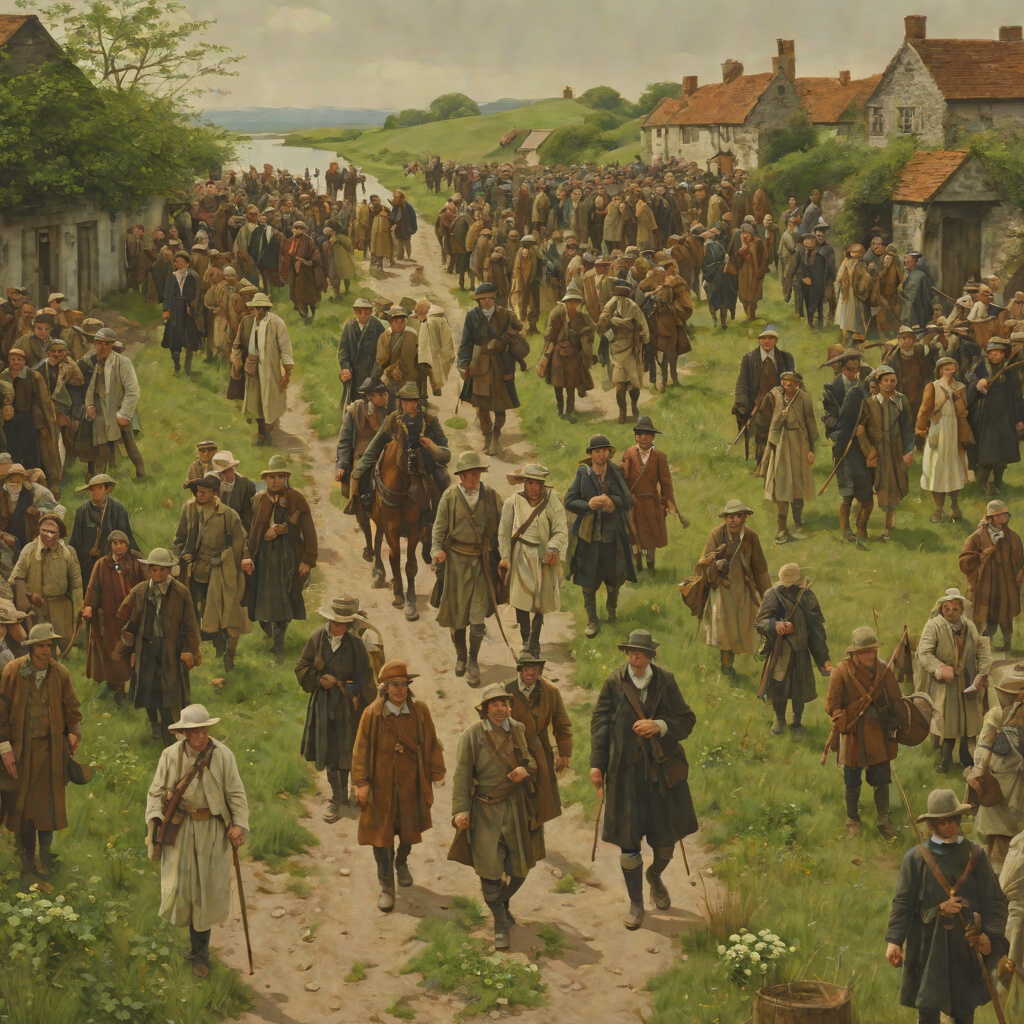
The Unlikely Pilgrimage of Harold FryThe Pilgrims are the informal, ever-changing assembly of strangers who join Harold Fry on his walk from Kingsbridge to Berwick-upon-Tweed, converting his private act of faith into a public phenomenon. They appear on Harold's forty-seventh day of walking, when he is joined by a middle-aged woman named Kate and a father of two, and they grow into a crowd of campaigners, ramblers, families, dropouts, tourists, and musicians. Their presence transforms the nature of the journey itself: what had been a solitary, meditative pilgrimage becomes a collective enterprise, complete with banners, camp fires, debates, physical warm-ups, and music. Yet the group's internal tensions, its hunger for recognition, and its eventual splintering test Harold's resolve more severely than any physical hardship, and their departure leaves him wearier and more isolated than he had been before they arrived. The Pilgrims embody both the novel's faith in human connection and its sharp critique of how easily belief can be co-opted by ego, commerce, and the machinery of publicity.
Origins and the Idea of the Pilgrimage
The Pilgrims' story begins not with their arrival but with the idea that drew them. Harold's journey is itself framed as a pilgrimage from its earliest moments: the novel's epigraph invokes the resolve of a pilgrim who will not relent from his first avowed intent, and Harold's decision to walk comes to him in a phone box as a sudden, wordless certainty. He tells the voice on the other end of the line that Queenie Hennessy has only to wait, because he is going to save her: 'I will keep walking and she must keep living.' This conviction—that his walking can sustain her life—is the seed from which the Pilgrims grow. When Harold later meets a young man named Mick south of Coventry, Mick names what Harold is doing: 'What you're doing is a pilgrimage for the twenty-first century. It's awesome. Yours is the kind of story people want to hear.' Mick's words are prophetic, for the story does spread, and the people who hear it begin to seek Harold out. The Pilgrims are thus born from a paradox: Harold's intensely personal act of faith becomes legible to others as a shared cause, and the more people believe in Queenie, the more Harold himself wonders if her chances of survival might be greater.
Growth and the Spirit of Community
As the group swells, it develops a self-conception that is new to Harold. They tell themselves they are no longer an assortment of torsos and feet and heads and hearts but one single energy, bound by Queenie Hennessy. They put up tents, unroll sleeping bags, and sleep beneath the sky, promising that Queenie will live. The daily rhythm of the walk changes: the greater the numbers, the slower they become, for they must accommodate the less experienced walkers and feed them as well. There are roast potatoes, garlic on sticks, and beetroot in foil; Rich, a man with a book about natural foraging, insists on making hogweed fritters. The daily mileage drops, sometimes to no more than three miles. Harold, who had been walking by day or by night as the mood took him, now finds himself bound to the group's pace. Yet he is touched by their commitment, and he knows, in a deeper way than before, that the walk can work. The group's faith in Queenie is genuine, and for a time it seems to magnify Harold's own.
Tensions and the Machinery of Publicity
Within only a few days, however, the community begins to fray. Kate has no time for Rich, calling him an egomaniac, while he calls her a bitter cow. During one evening, both the gorilla man and a visiting student sleep with the same primary-school teacher, and Rich's attempts to resolve the animosity threaten to end in a punch-up. Wilf cannot stop trying to convert fellow walkers to God, or asking for prayers to be said for Queenie, and this leads to further aggravation. When an amateur walking group pitches up for the night, more disagreements erupt: some argue that tents are not in the true spirit of Harold's journey, some want to avoid roads altogether and head towards the more challenging Pennine Way, and Rich raises the question of roadkill, sparking off another round. Harold listens with growing unease. He does not mind where people sleep, or how they walk, or what they eat. He simply wants to get to Berwick. The turning point comes when Rich announces that something is needed to distinguish the real pilgrims from their followers. He has been in touch with an old friend in PR, who has contacted the distributors of a health drink, and they will provide all official walkers with T-shirts bearing the word PILGRIM on the front and back, in white and in three sizes. Kate scoffs at the colour, asking where they are going to wash these things; Rich insists that white stands out and that its image is pure, to which Kate replies, 'There speaks a man; and bollocks.' The company will also supply a limitless amount of healthy fruit drinks, in return for Harold being seen holding one as often as possible. When the T-shirts arrive, a press call is organized, and Harold is to be joined on the A617 by Miss South Devon for the photoshoot. Harold objects, saying the others should be in it too, since they have made a commitment to the walk as well as him. Rich replies that this would cloud the message about faith for the twenty-first century, and also weaken the Queenie love story.
The Splintering and the Aftermath
The group's dissolution comes as swiftly as its formation. Rich, frustrated by Harold's refusal to prioritize speed, proposes a splinter group that will push straight up to Berwick, arguing that Queenie is dying and that they could be there in a week. No one expresses an opinion that night, but by morning Kate discovers that a great deal of campaigning has taken place in the dark: whispered conversations in tents and over the dying embers of the fire have confirmed Rich's view. They all love Harold, but it is time to break free. They look for the old man but cannot find him, and they pack up their sleeping bags and tents and are gone. Apart from the smouldering embers of a fire, the field is so empty that Kate could almost doubt any of it had happened. She finds Harold sitting by a river, throwing stones for the dog, his shoulders hunched as if a weight presses down on him. It shocks her, how old he suddenly looks. She tells him that Rich has persuaded the gorilla man to go ahead, and that they have taken the well-wishers and what was left of the journalists. Rich called a meeting and gave some story about Harold needing a break, even squeezing out a few tears. Harold replies that he does not mind; to tell the truth, it was getting too much. He removes the pilgrim T-shirt and retrieves his shirt and tie from his rucksack, screwed up and very worn now, but it is like being himself again as he puts them on. He considers taking the T-shirt to Queenie as a souvenir, but it does not feel right to carry something that has caused such dispute, so he slips it in a bin when no one is looking. A week after the split, reports come of the pilgrims' arrival in Berwick-upon-Tweed. There are photographs in the newspapers of Rich Lion walking hand in hand with his two sons along the quay, and others of a man in a gorilla suit nuzzling the cheek of Miss South Devon. There is a brass band to welcome the party, a performance by the local cheerleading troupe, and a dinner attended by local councillors and businessmen. Several Sunday papers claim to have sole access to Rich's diaries, and there is talk of a film. The pilgrims' arrival is also covered on television news: courtesy of BBC Spotlight, Maureen and Rex watch footage of Rich Lion and several others delivering flowers to the hospice along with a giant basket of muffins, although Queenie is unable to receive them. The reporter adds that sadly no one from the hospice is available for comment. Maureen's reaction is one of disgust: 'Those people didn't even know Queenie. It makes me want to spit. Why couldn't they wait for Harold?'
Significance: The Fate of Faith in Public
The Pilgrims' arc is the novel's most sustained meditation on what happens to faith when it becomes public. Harold's own belief is fragile, as he himself knows; he has learned that it is the smallness of people that fills him with wonder and tenderness, and the loneliness of that too. The world is made up of people putting one foot in front of the other, and a life might appear ordinary simply because the person living it has done so for a long time. The Pilgrims begin as an expression of this insight—a community of the lonely, bound by a shared hope—but they are gradually overtaken by the very forces Harold has walked away from: ego, commerce, and the hunger for recognition. Rich's T-shirts and press calls, the health-drink sponsorship, and the final, theatrical arrival in Berwick all reduce the pilgrimage to a spectacle, a story for the newspapers rather than an act of love. Harold's quiet disposal of the pilgrim T-shirt is his rejection of that reduction, a return to the shirt and tie of his ordinary self. The Pilgrims thus serve as both the proof and the peril of Harold's journey: they demonstrate that his walk has touched others, that belief can be shared, but they also show how easily that shared belief can be stolen, packaged, and sold. In the end, the group's departure is not a failure of Harold's faith but a purification of it, leaving him alone once more with the only thing that ever mattered: the simple, relentless act of putting one foot in front of the other.